
Holy Week Day by Day
 Holy Week is a time of high drama as Jesus heads into the final confrontation. The tension builds day by day until it ends in Jesus’ death and resurrection.
This year we are offering a daily series of recorded reflections that help us engage the story of Holy Week by following Jesus day by day.
Flow States and Spirituality at Work
 If you have experienced a state of flow, you probably remember it as quite enjoyable. It is usually associated with heightened concentration, deeper awareness, and greater effectiveness, and is sometimes thought of as being “in the zone.” Most of us would probably like to spend more time in flow, whether in leisure activities or work.
The state of flow is considered a positive psychological condition and has been researched primarily from a nonreligious point of view, and appropriately so. But I believe there could also be a religious or spiritual dimension to this experience. Being aware of this possible spiritual dimension might help us move more easily toward a flow state.
Entrepreneurs and the Renewal of Hope

Our ancestors survived threatening circumstances and created a better world, and so will we. Despite our problems, we can still contribute to the greater good and build better lives, each in our own way. For those of us in business, this means working with courage and hope as we identify new opportunities and build a better future.
This article looks at the important research by C. R. Snyder and his colleagues and combines it with Biblical insights.
Active hope can be a powerful force as we move into the future, especially if it is spiritually grounded. It will be essential for the entrepreneurial renewal our society needs.
Why Work? (Comments on Dorothy Sayers’ Famous Essay)

A Response to a Classic Essay on Work
In her 1942 essay “Why Work?” Dorothy Sayers made a strong case that we should not undertake work for the money it provides but for the sake of the work itself. This is a compelling idea that pushes back against some of the negativity surrounding the concept of work.
But she also criticized the validity of money as a motivation for working, beyond meeting basic needs, and seemed to think our work should not take into account the needs and wants of others. Both of these points can be challenged.
New Book: The Sacred Meaning of Everyday Work
 I am happy to say that after lots of research, discussion, writing, and editing, The Sacred Meaning of Everyday Work is now available on The book is available on Amazon. Thank you to everyone who has provided advice and insight over the years.
The book covers a range of topics, but the overall theme is that your own faith or spirituality can help you find the deeper meaning and purpose in your work life. It offers insights for the reader’s consideration from the Bible, contemporary research (especially positive psychology and organizational behavior), and business experience.
Work Life Ministries: The Opportunity for Churches
 Many people want to experience a deeper sense of purpose and fulfillment in their work; a church-based faith and work ministry can help them achieve this. It can help them develop a more profound sense of God’s presence as they go through their workweek, understand how their work can contribute to the well-being of others, and build community. Churches can also provide spiritual practices that can be integrated into the workday.
This is an opportunity for churches to provide an important service to working adults both inside and outside the church. (Free Reprint)
Building Collaborative Relationships: The Role of Personal Values

Collaboration and collaborative relationships are the key to success in business and most other professions. These relationships are in turn heavily dependent on the values we bring to our work—values like honesty, compassion, humility, transparency, patience, and courage. These values are also the ones usually taught by the church and most other religious institutions. In this episode we talk about these values and why collaboration is so important to the production of value in business.
Work-Related Burnout

Elijah in the Wilderness
After a prolonged struggle with King Ahab and the priests of Baal, the great prophet Elijah was completely exhausted. He journeyed by himself into the desert and asked God to take his life; he then lay down under a broom tree and fell asleep, awaiting death. Elijah’s friends and allies were gone, he had failed to save Israel, and he was too tired to go on.
But an angel sent by God awoke Elijah and gave him food and drink. After more rest, the angel brought Elijah to Mount Horeb to meet God in a cave.
After experiencing a great wind, a powerful earthquake, and a fire, Elijah encountered sheer silence within which he heard the voice of God sending him back out to fulfill his calling. And so Elijah, refreshed, returned with power to the world and did indeed fulfill his calling from God. (Adapted from 1 Kings 19)
From our vantage point, it is not too hard to see Elijah as an extreme case of work-related burnout. He was exhausted, he was without friends, and he felt like a failure. Burnout is a big problem; if we have not experienced it ourselves, we probably will at some point in the future and in any case we probably know somebody who is confronting burnout right now. But there are things that we can do.
Prayer and Our Sense of Mission
 A Reflection on Mark 1:35-39
Early in his ministry, Jesus went off and prayed by himself in the early morning hours while it was still dark and emerged with a clearer, more powerful sense of mission. This story might have an essential insight for us as we consider the relationship between prayer and the sense of mission we bring to our work.
Video Archive: Michael Novak on Business as a Calling
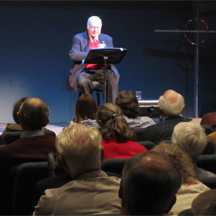 In April 2010, the Center for Faith and Enterprise brought scholar Michael Novak (1933-2017) to California for a speaking tour. We sponsored speaking events at Fuller Theological Seminary in Pasadena (hosted by the Max De Pree Center for Leadership), Biola University in La Mirada, and La Canada Presbyterian Church in La Canada/Flintridge.
At La Canada Presbyterian, the subject was Business as a Calling. In this talk, Novak provided an update on his thinking fourteen years after the publication of his classic book by the same name.
Michael’s observations remain very insightful for today’s business environment.
Video: Sam Alibrando on Working With Difficult People
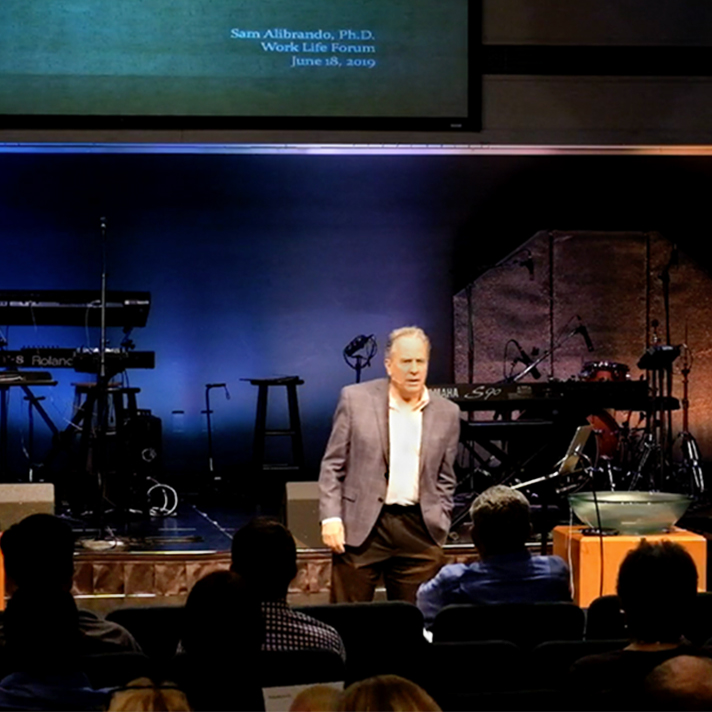 On June 18, the third Work Life Forum featured Dr. Sam Alibrando speaking on the subject “Working with Difficult People”. The event was held at La Canada Presbyterian Church in La Canada, California. The video of Dr. Alibrando’s presentation is now available.
The fulfillment, satisfaction, and enjoyment we find in our work are heavily dependent on the quality of our working relationships. There is very little in our work that can make us as miserable as a painfully difficult working relationship; the pain and stress of a bad working relationship can even bleed over into the rest of our life.
Video: Scott Symington Speaks on Stress at Second Work Life Forum
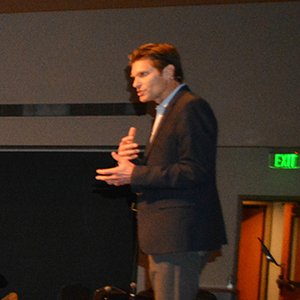 At our second Work Life Forum, 199 people heard Dr. Scott Symington preview his forthcoming new book Freedom from Anxious Thoughts and Feelings: A Two-Step Mindfulness Approach for Moving Beyond Fear and Worry. Dr. Symington discussed specific steps that can help us break free from our worries, address the challenges we face more effectively, and live more fully. Along the way presented a ground breaking new tool called the Two Screen Method.
The event video is available at the link.
Noon Prayer Meetings and the Revival of 1857/58: The Workplace Connection
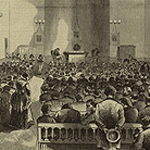
A Case Study: The Fulton Street Prayer Meetings
A powerful revival occurred in 1857 and 1858. Sometimes known as the
“Businessmen’s Revival” by its contemporaries, a distinctive aspect of the revival was the extraordinary popularity of noon prayer meetings organized and led by business people. These meetings built on the pattern established by the Fulton Street Prayer Meetings.
There are important lessons that can be drawn from this success of this movement and the manner in which the prayer meetings were organized.
This is an updated version of an earlier article.
Video: Peter Hill Speaks on Humility
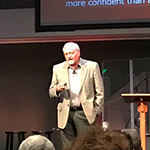
On October 30, 2018, Dr. Peter Hill spoke to our first Work Life Forum and presented the results of new research he and a multi-university team has developed about humility. A video of the event is now available;.
Humility is often misunderstood. It is not self-effacement or meekness, but involves having an accurate, ego-free assessment of ourselves, our abilities, and our limitations, and then being able to act accordingly. As such, humility can play an important role in how we deal with the stresses and conflicts in our work life. It can help us see and respond to circumstances more clearly and effectively, lower our stress levels, and improve our working relationships.
Chronic Time Pressure
 When people talk about their more frustrating work-related problems, quite often the issue of time, or the lack of it, comes up. For many people, there is not enough time to get everything done and this can be a serious and chronic source of stress. It seems as though fixing this one problem might make a huge difference in many people’s lives and in their ability to enjoy their work and their leisure.
Professor of Psychology Alex Szollos has put forward a very insightful and I believe useful idea. He suggests that chronic time pressure, that feeling of always being short of time, should be seen as an overarching concept that incorporates two related but distinct elements: 1) an objective element, in other words, an actual shortage of time relative to the demands placed on the individual; and 2) a subjective element, in other words, the subjective experience of being harried and rushed pretty much all of the time.